Electric Motors for EVs: Complete Guide to Types and Applications
Introduction: The Role of Electric Motors in Modern EVs
The automotive industry is moving toward cleaner and more energy-efficient transportation. Electric vehicles (EVs) play a major role in this transformation. Growing environmental concerns, rising fuel costs, and technological innovation continue to encourage EV adoption.
Electric motors form the heart of every electric vehicle’s propulsion system. They convert electrical energy into mechanical power to drive the wheels. Unlike traditional combustion engines, electric motors deliver smooth acceleration and responsive torque.
Different electric vehicles require different motor technologies. Electric scooters, passenger cars, buses, and commercial trucks have unique performance needs. Manufacturers select motors based on efficiency, power, cost, and durability.
Understanding electric motors for EVs helps manufacturers, engineers, suppliers, and automotive professionals make informed decisions. This guide explores the major motor types, working principles, applications, and future developments.
What Is an Electric Motor in an EV?
An electric vehicle motor converts electrical energy into rotational mechanical energy. This mechanical energy powers the vehicle’s wheels and enables movement.
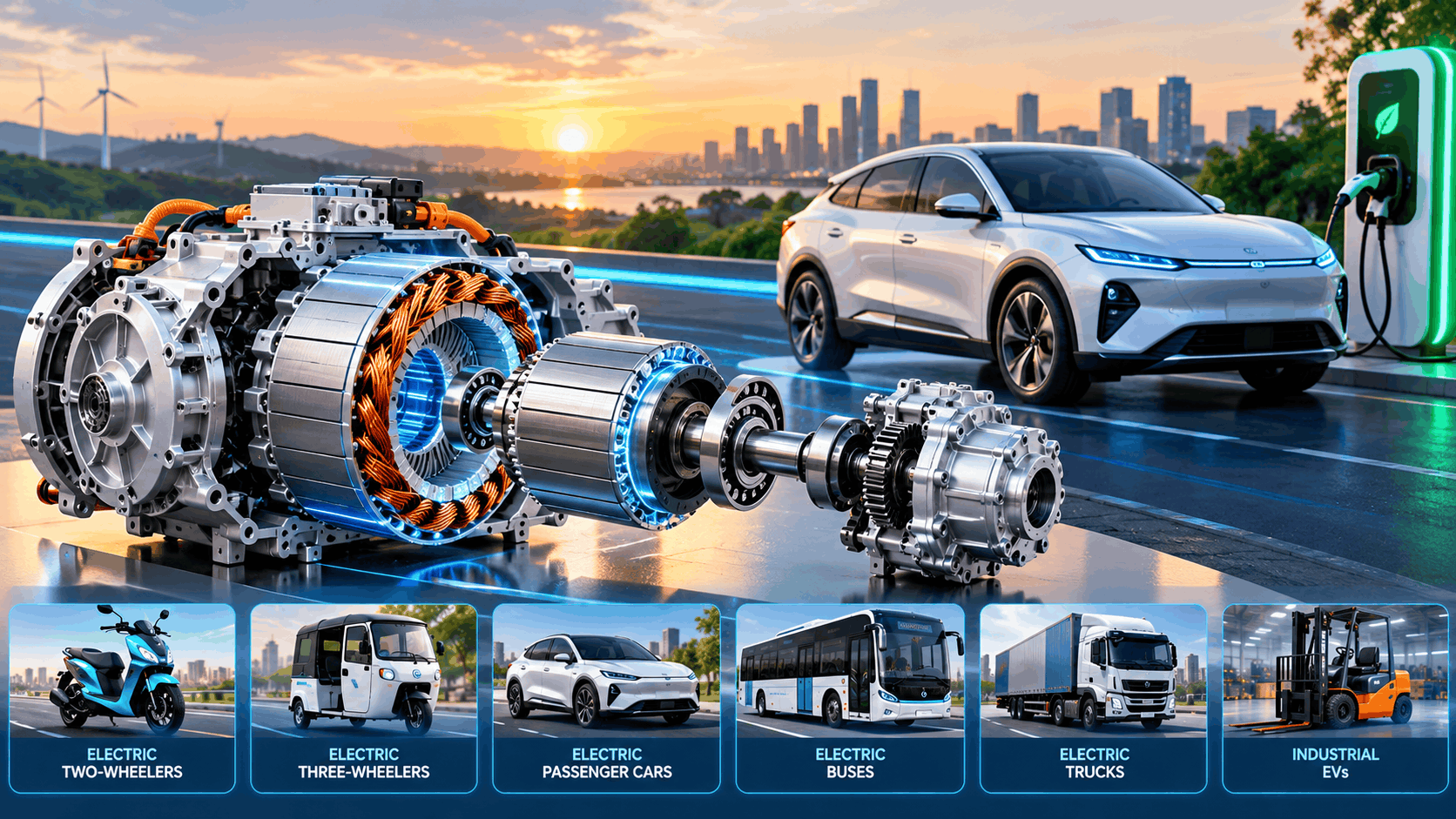
Most modern EV motors contain two main components: a stator and a rotor. The stator remains stationary and creates a magnetic field. Meanwhile, the rotor rotates through electromagnetic interaction and generates mechanical torque.
The motor works with several other powertrain components. These include the traction battery, inverter, controller, and transmission.
Motor performance directly affects vehicle acceleration, energy consumption, and driving efficiency. Therefore, manufacturers focus on compact designs, high torque, and reliable operation.
Modern electric motors also require effective cooling systems. Proper thermal management protects components and helps maintain performance during demanding driving conditions.
How Do Electric Motors Work in Electric Vehicles?
Electric motors operate through electromagnetic principles. The vehicle’s battery stores electrical energy and supplies power to the propulsion system.
In most modern electric vehicles, an inverter converts direct current (DC) into controlled alternating current (AC). The motor receives this electrical power and produces rotational motion.
The stator creates a rotating magnetic field. This field interacts with the rotor and generates torque. A transmission or reduction gear then transfers power to the wheels.
Electronic controllers regulate motor speed and torque. They respond to accelerator inputs, driving conditions, and vehicle requirements.
Electric vehicles also use regenerative braking to improve energy efficiency. During suitable deceleration conditions, the motor acts as a generator. It converts some kinetic energy into electricity and sends it back to the battery.
This process reduces energy waste and can extend the vehicle’s driving range.
Types of Electric Motors Used in EVs
Electric vehicle manufacturers use several motor technologies. Each type offers different performance characteristics, advantages, and limitations.
The most common technologies include Brushless DC Motors, Permanent Magnet Synchronous Motors, and AC Induction Motors. Other designs include Brushed DC Motors, Switched Reluctance Motors, and Electrically Excited Synchronous Motors.
1. Brushless DC Motors (BLDC Motors)
Brushless DC Motors are popular in electric scooters, e-bikes, and lightweight electric vehicles. They use electronic controllers instead of mechanical brushes to manage motor operation.
This design reduces mechanical wear and maintenance requirements. BLDC motors also offer compact construction, good efficiency, and responsive torque delivery.
Manufacturers often use BLDC hub motors in electric two-wheelers. These motors fit directly inside the wheel assembly and simplify certain drivetrain designs.
However, BLDC motors require suitable electronic controllers. Their performance also depends on cooling, operating conditions, and motor design.
For lightweight electric mobility, BLDC motors offer a practical balance of efficiency, cost, and performance.
2. Permanent Magnet Synchronous Motors (PMSM)
Permanent Magnet Synchronous Motors play an important role in modern electric passenger cars. They use permanent magnets in the rotor to create a magnetic field.
PMSM technology offers high efficiency and excellent power density. Its compact design helps manufacturers save space and reduce drivetrain weight.
These motors also deliver strong torque and smooth acceleration. As a result, many automotive manufacturers choose PMSM systems for efficient electric propulsion.
However, some PMSM designs rely on rare-earth magnetic materials. These materials can increase production costs and create supply-chain challenges.
To address these issues, manufacturers continue to explore alternative magnets and improved motor designs.
3. AC Induction Motors
AC Induction Motors provide another reliable option for electric vehicle propulsion. They generate rotor current through electromagnetic induction.
Unlike permanent magnet motors, induction motors do not need permanent magnets in the rotor. This feature can reduce dependence on rare-earth materials.
Induction motors offer robust construction and reliable operation. They also perform across a wide range of operating speeds.
However, rotor electrical losses can affect efficiency. Some designs may also have lower power density than optimized permanent magnet motors.
Despite these limitations, induction motors remain valuable for several electric mobility applications.
4. Brushed DC Motors
Brushed DC Motors represent one of the earliest electric motor technologies. They use mechanical brushes and a commutator to control current flow.
Their simple design makes them relatively easy to operate and control. These motors can provide suitable torque for low-speed applications.
Electric carts, small utility vehicles, and basic mobility equipment have historically used brushed DC motors.
However, mechanical brushes wear over time. This creates maintenance needs and limits their suitability for demanding traction applications.
Modern electric passenger vehicles generally favor brushless technologies because they offer better durability and control flexibility.
5. Switched Reluctance Motors (SRM)
Switched Reluctance Motors offer an alternative approach to electric vehicle propulsion. They generate torque by changing magnetic reluctance within the motor.
Their rotor has a simple and rugged construction. It does not require permanent magnets or electrical rotor windings.
This design may reduce material costs and simplify certain manufacturing processes. It also creates opportunities for rare-earth-free motor development.
However, switched reluctance motors can generate vibration, acoustic noise, and torque ripple.
Engineers use advanced motor control and improved designs to reduce these issues. As research progresses, SRM technology may gain wider use in electric mobility.
6. Electrically Excited Synchronous Motors (EESM)
Electrically Excited Synchronous Motors use electrical excitation to generate a magnetic field in the rotor.
Unlike permanent magnet motors, these designs do not require permanent magnets. Instead, they use controlled electrical current to create rotor magnetism.
This approach allows engineers to adjust the magnetic field according to operating conditions. It can also reduce reliance on rare-earth materials.
However, the excitation system adds design complexity. Engineers must also manage additional electrical losses and cooling requirements.
EESM technology offers manufacturers another option for developing efficient electric vehicle powertrains.
Applications of Electric Motors Across EV Segments
Electric motors power many types of electric vehicles. Each vehicle category requires a different combination of torque, power, efficiency, and durability.
Electric Two-Wheelers
Electric scooters and motorcycles require compact and lightweight propulsion systems. Manufacturers frequently use BLDC and permanent magnet motors in these vehicles.
Hub motors offer simple packaging for certain scooter designs. Mid-drive systems provide another option for distributing power through the drivetrain.
Motor selection depends on vehicle weight, acceleration, efficiency, and production cost.
Electric Three-Wheelers
Electric auto-rickshaws and cargo three-wheelers require reliable torque delivery. Frequent stopping, starting, and varying loads create demanding operating conditions.
BLDC and permanent magnet motors serve many applications in this segment. Manufacturers choose suitable systems based on payload, speed, and efficiency requirements.
Electric Passenger Cars
Electric passenger cars need efficient motors that deliver strong acceleration and smooth performance.
PMSM and AC Induction Motors are established options. Some manufacturers also use electrically excited synchronous motor technology.
Vehicle designers consider driving range, thermal management, power density, and cost when selecting a motor.
Electric Buses and Commercial Vehicles
Electric buses and commercial trucks operate under demanding conditions. Heavy loads and continuous operation increase the need for durable motor systems.
Manufacturers select high-performance traction motors according to vehicle weight, route conditions, and duty cycles.
Effective cooling systems also help maintain reliable performance during extended operation.
Electric Industrial and Utility Vehicles
Electric motors also power forklifts, warehouse vehicles, agricultural equipment, and utility carts.
These applications prioritize reliability, precise control, and operating efficiency.
Manufacturers select motor technologies according to the working environment, load requirements, and operating conditions.
Key Factors When Choosing an Electric Motor for EVs
Choosing the right electric motor requires careful evaluation. Manufacturers must balance efficiency, performance, cost, and reliability.
Motor Efficiency: Higher efficiency reduces energy losses and can improve driving range. However, actual performance depends on operating conditions and drivetrain design.
Torque and Power: Torque influences acceleration and pulling capability. Power determines how effectively the motor can sustain performance at different speeds.
Power Density: High power density allows manufacturers to achieve strong performance using compact motor designs.
Thermal Management: Effective cooling systems help control operating temperatures and protect motor components.
Manufacturing Cost: Material selection, production methods, and control electronics affect overall motor costs.
Durability: Reliable motors must withstand vibration, temperature changes, and demanding operating conditions.
Control System: Advanced motor controllers improve torque regulation, driving response, and system efficiency.
A successful motor design balances these factors according to the vehicle’s intended application.
Challenges in Electric Motor Manufacturing
Electric motor manufacturers face several technical and economic challenges. Rising demand for advanced EV components creates pressure to improve production efficiency and control costs.
Raw material availability remains an important concern. Certain permanent magnet motors require rare-earth materials, which can face price fluctuations and supply constraints.
Thermal management presents another challenge. High-performance motors generate heat during operation. Manufacturers must design cooling systems that maintain safe operating temperatures.
Production quality also plays a critical role. Precision manufacturing, insulation quality, and accurate assembly support motor reliability.
In addition, manufacturers must integrate motors with inverters, control systems, and transmissions. Poor integration can reduce drivetrain efficiency and overall performance.
To remain competitive, companies continue to invest in automation, advanced materials, and improved testing methods.
Future Trends in Electric Motor Technology
Electric motor technology continues to evolve as manufacturers seek better efficiency, compact construction, and lower costs.
Axial-Flux Motors
Axial-flux motors offer an alternative motor geometry. Their magnetic flux travels along the rotational axis rather than primarily across it.
Certain designs can provide high torque density and compact packaging. These features make axial-flux technology attractive for specialized EV applications.
Rare-Earth-Free Motor Technology
Manufacturers are exploring motor designs that reduce dependence on rare-earth magnets.
Induction motors, switched reluctance designs, and electrically excited synchronous motors offer potential alternatives.
Researchers also continue to investigate improved magnetic materials and efficient motor architectures.
Integrated Electric Drive Systems
Integrated e-axles combine motors, inverters, gearboxes, and related components into compact assemblies.
This approach can reduce packaging complexity and simplify vehicle integration.
As technology improves, integrated drive systems may support more compact and efficient EV powertrains.
Advanced Motor Cooling
Improved cooling systems help electric motors operate efficiently under demanding conditions.
Manufacturers are developing better cooling channels, thermal materials, and heat-management techniques.
These innovations can support higher power density and improved reliability.
Advanced Power Electronics
Modern EV powertrains increasingly benefit from improvements in semiconductor technology.
Silicon carbide power electronics can improve efficiency in suitable applications. Advanced motor controllers also support precise torque delivery and efficient operation.
Together, these innovations can improve the overall performance of electric drive systems.
The Future of Electric Motors in India
India’s expanding electric mobility ecosystem creates opportunities for motor manufacturers, automotive component suppliers, and technology companies.
Electric two-wheelers, three-wheelers, passenger cars, and commercial vehicles require different propulsion solutions. This diversity encourages innovation in motor design and manufacturing.
Domestic component development can also strengthen supply chains and reduce dependence on imported technologies.
Indian manufacturers can explore opportunities in motor assemblies, stator and rotor production, electronic controllers, cooling systems, and integrated drive units.
However, long-term growth will require continued investment in research, manufacturing quality, skilled workers, and technology development.
As electric mobility expands, efficient and affordable motor technologies will remain essential for India’s automotive industry.
Conclusion: Electric Motors Powering the Future of Mobility
Electric motors play a central role in the growth of electric mobility. They determine how efficiently vehicles convert electrical energy into motion.
Different motor technologies serve different transportation needs. BLDC motors support many lightweight EV applications, while PMSM and induction motors power a wide range of passenger and commercial vehicles.
Meanwhile, switched reluctance and electrically excited synchronous motors provide alternatives for manufacturers exploring new designs.
Innovation in materials, cooling systems, power electronics, and integrated drive technology will continue to shape the industry.
The future of electric mobility depends on efficient motors, advanced engineering, reliable components, and continuous technological innovation. As manufacturers improve these systems, electric vehicles can become more efficient, affordable, and practical for a wider range of users.
Share this content:
Post Comment