Permanent Magnet vs Induction Motor: Which Technologies Power EVs?
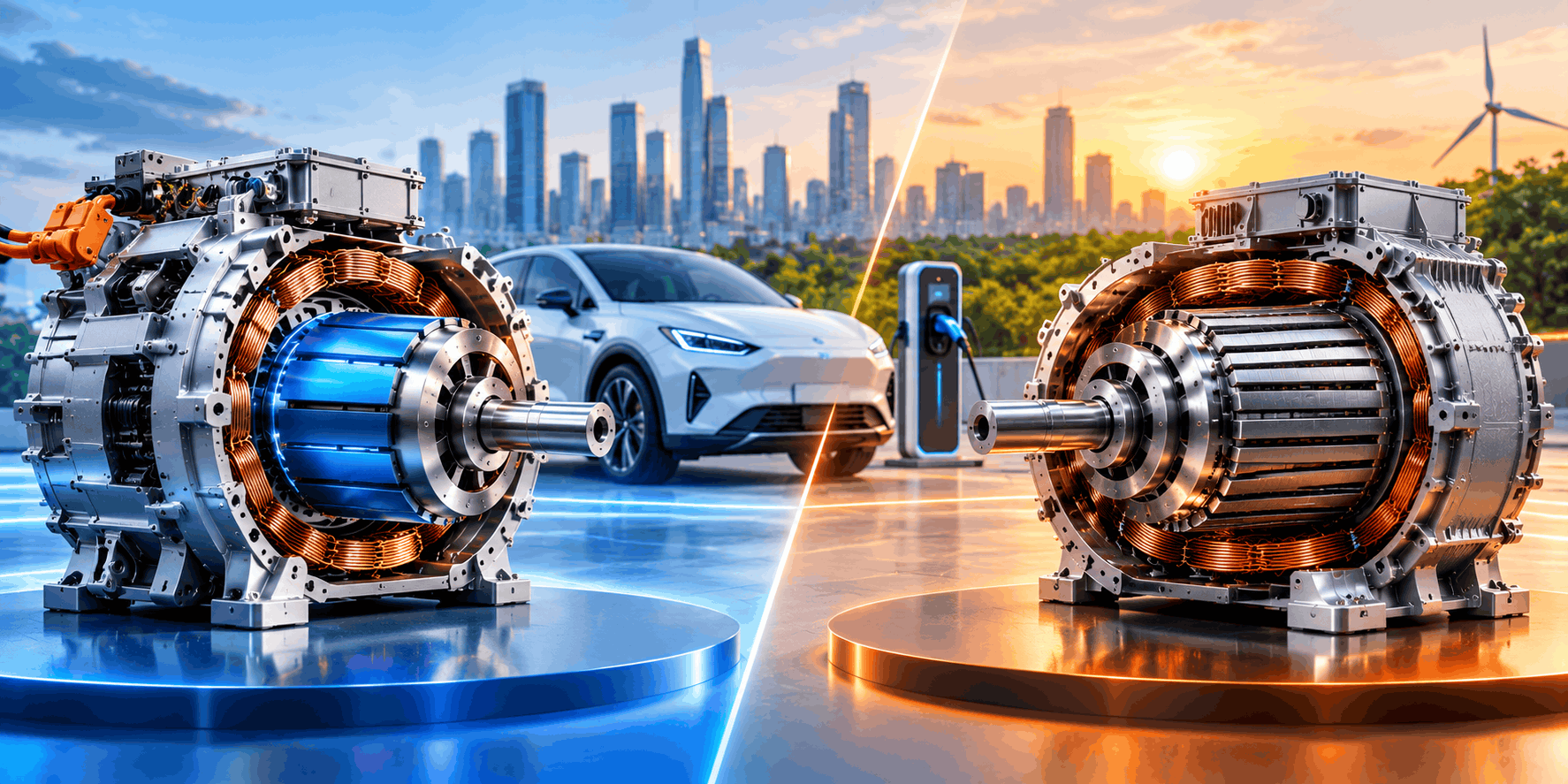
The electric vehicle (EV) industry is transforming the future of transportation through advancements in energy efficiency, performance, and sustainable mobility. While batteries are often considered the heart of electric vehicles, electric motors play an equally important role in determining how efficiently battery energy is converted into motion. From acceleration and driving range to power delivery and energy consumption, motor technology significantly influences overall vehicle performance.
Among the various electric motor technologies used in electric vehicles, Permanent Magnet Synchronous Motors (PMSMs) and Induction Motors (IMs) are two prominent solutions. Both technologies convert electrical energy into mechanical energy, but their operating principles, efficiency characteristics, manufacturing requirements, and material dependencies differ. Understanding these differences is essential for automotive manufacturers, EV component suppliers, engineers, researchers, and businesses involved in the rapidly growing electric mobility sector.
Understanding Electric Motor Technology in Electric Vehicles
An electric motor is a fundamental part of an EV’s powertrain, responsible for converting electrical energy from the battery into mechanical power that drives the wheels. Unlike conventional internal combustion engines, electric traction motors can deliver high torque at low speeds, enabling smooth acceleration and responsive vehicle performance. Modern EV powertrains generally combine electric motors with inverters, controllers, cooling systems, and transmission components to achieve efficient and reliable operation.
The two major components of an electric motor are the stator and rotor. The stator is the stationary component that produces a rotating magnetic field, while the rotor is the moving component responsible for generating mechanical rotation. The interaction between these components determines how the motor produces torque. Although permanent magnet and induction motors share similar fundamental structures, their methods of producing rotor magnetic fields are different.
What Is a Permanent Magnet Synchronous Motor (PMSM)?
A Permanent Magnet Synchronous Motor is an electric motor that uses permanent magnets embedded in or mounted on the rotor to create a magnetic field. These magnets interact with the rotating magnetic field produced by the stator, causing the rotor to rotate at synchronous speed. Many high-performance PMSMs use rare-earth magnetic materials such as neodymium and praseodymium, which provide strong magnetic properties and support compact motor designs.
Permanent magnet motors are widely considered suitable for modern electric vehicles because of their high efficiency, compact size, and excellent power density. Since the rotor’s magnetic field is generated by permanent magnets, the motor does not require electrical current to establish that magnetic field in the rotor, reducing certain electrical losses.
Advantages of Permanent Magnet Motors
One of the primary advantages of PMSMs is their high energy efficiency, particularly during operating conditions involving moderate loads. This can help electric vehicles use battery energy more effectively and support driving range optimization. Their high power density also allows manufacturers to design compact and lightweight electric drive systems without sacrificing performance.
Permanent magnet motors provide precise torque control and responsive acceleration, making them attractive for passenger cars, electric two-wheelers, and other electric mobility applications. Their compact construction can also simplify powertrain packaging and improve the efficient use of available vehicle space.
Limitations of Permanent Magnet Motors
Despite their advantages, permanent magnet motors present certain challenges. The use of rare-earth materials can increase manufacturing costs and create supply chain dependencies. Magnet prices may fluctuate due to changes in global demand, processing capacity, and material availability.
Additionally, permanent magnets can be sensitive to excessive temperatures, making effective thermal management essential. Engineers must also consider magnet-related losses, high-speed operating characteristics, and motor control requirements when designing PMSM-based electric powertrains.
What Is an Induction Motor?
An Induction Motor, also known as an asynchronous motor, operates using electromagnetic induction rather than permanent magnets. When alternating current flows through the stator windings, it produces a rotating magnetic field that induces electrical currents in the rotor. These induced currents generate a magnetic field that interacts with the stator field, creating torque and causing the rotor to rotate.
Unlike permanent magnet motors, induction motors do not require rare-earth magnets to operate. Their rotor is commonly constructed using conductive aluminum or copper bars arranged in a squirrel-cage configuration. This design makes induction motors a proven and robust option for various industrial and automotive applications.
Advantages of Induction Motors
One of the most significant advantages of induction motors is their ability to operate without permanent magnets, reducing dependence on rare-earth materials. This can provide manufacturers with greater flexibility in material sourcing and help reduce exposure to magnet supply chain fluctuations.
Induction motors are also valued for their durability, established manufacturing processes, and reliable performance under demanding conditions. They can operate across a wide speed range when combined with suitable inverter technology and advanced motor control systems. Their proven construction makes them a practical option for EV manufacturers seeking alternative motor architectures.
Limitations of Induction Motors
Although induction motors offer several advantages, they can experience higher electrical losses because currents must be induced in the rotor to generate torque. These rotor losses produce heat and may reduce efficiency compared with equivalent permanent magnet motors under certain operating conditions.
Induction motors may also require larger or heavier designs to achieve similar power density, depending on engineering specifications. However, improvements in power electronics, motor control, rotor materials, and cooling systems continue to enhance induction motor performance.
Permanent Magnet vs Induction Motor: Key Differences
The primary difference between permanent magnet and induction motors lies in how they produce the rotor magnetic field. PMSMs use permanent magnets, while induction motors rely on electromagnetic induction. This fundamental distinction affects their efficiency, manufacturing costs, material requirements, and overall performance characteristics.
Permanent magnet motors generally offer higher power density and strong efficiency, making them attractive for vehicles where energy consumption, compact packaging, and driving range are important considerations. Induction motors offer the advantage of magnet-free construction, established manufacturing technology, and reduced reliance on rare-earth materials.
In terms of thermal performance, both technologies require effective cooling systems. PMSMs must operate within safe magnet temperature limits, while induction motors must manage additional rotor heating caused by induced currents. Both can provide strong acceleration and precise torque control when equipped with suitable power electronics.
Ultimately, neither motor technology is universally superior. Their advantages depend on the specific vehicle application, operating conditions, powertrain architecture, and manufacturing priorities.
Which Motor Technology Offers Better Efficiency and Driving Range?
Efficiency is one of the most important factors influencing electric vehicle design because it directly affects battery energy consumption. A motor that converts more electrical energy into useful mechanical output can help improve overall powertrain efficiency and potentially increase driving range.
Permanent magnet motors often demonstrate favorable efficiency characteristics, particularly at partial loads, because they avoid rotor current losses associated with producing the magnetic field. This advantage can be valuable during everyday driving conditions involving frequent changes in speed and load.
Induction motors can also achieve high efficiency when operating within optimized speed and load ranges. However, their rotor current losses can influence overall energy consumption. Modern inverter systems, sophisticated control algorithms, and improved cooling technologies help manufacturers manage these losses.
It is important to understand that the driving range of an electric vehicle depends on more than motor type. Battery capacity, vehicle weight, aerodynamics, driving behavior, ambient temperature, regenerative braking, and power electronics efficiency all contribute to the final result. Consequently, a well-engineered induction motor powertrain may outperform a less optimized permanent magnet system under certain conditions.
Cost Comparison: Permanent Magnet Motors vs Induction Motors
Manufacturing cost is another major consideration when selecting electric motor technology for EV applications. Permanent magnet motors often involve higher material costs because they require specialized magnets, which can contain expensive rare-earth elements. Rotor manufacturing and magnet installation also contribute to production complexity.
Induction motors eliminate permanent magnet expenses and benefit from well-established manufacturing processes. However, their overall system costs may be influenced by motor dimensions, conductive material requirements, cooling systems, and power electronics.
For automotive manufacturers, the most economical option is not necessarily the motor with the lowest initial manufacturing cost. Engineers must also consider efficiency, weight, performance, production volume, vehicle packaging, and long-term operating requirements. A more efficient motor may provide system-level benefits that help offset higher component costs.
Rare-Earth Materials and Sustainability Challenges
The growing electric vehicle industry has increased attention on the availability and environmental impact of materials used in electric motors. Many permanent magnet motors rely on neodymium-iron-bo
ron magnets, which provide strong magnetic properties and enable compact, high-performance motor designs.
However, rare-earth material extraction, separation, processing, and magnet manufacturing involve complex supply chains. Geographic concentration of production and processing can create challenges related to material availability, pricing, and supply security.
Induction motors offer an alternative because they do not require permanent magnets. This can reduce dependence on rare-earth magnet materials and support material diversification within the EV industry. Nevertheless, induction motors still require copper, aluminum, electrical steel, and other resources.
Therefore, environmental sustainability should be evaluated across the complete lifecycle of a motor, including raw material extraction, manufacturing, operating energy consumption, maintenance, and recycling.
Real-World Applications of Permanent Magnet and Induction Motors
Electric vehicle manufacturers use different motor technologies depending on vehicle design and performance requirements. Permanent magnet motors are commonly selected for applications where compact dimensions and high efficiency are priorities, while induction motors remain relevant where magnet-free construction, operating flexibility, and robust performance are desirable.
An example is the Tesla Model 3, whose published technical specifications identify a permanent magnet synchronous rear motor and an induction front motor in certain all-wheel-drive configurations. This demonstrates how manufacturers can combine different motor technologies within the same electric vehicle.
Such combinations allow engineers to optimize power distribution, driving characteristics, and efficiency according to vehicle requirements. Actual motor configurations may differ by model, production year, and market.
The Future of Electric Motor Technology in EVs
As electric mobility continues to evolve, automotive manufacturers and technology developers are exploring ways to improve motor efficiency, reduce material dependency, and lower manufacturing costs. Research into rare-earth-free and rare-earth-reduced motor technologies is becoming an important area of innovation.
Externally excited synchronous motors, synchronous reluctance motors, improved induction motor designs, and advanced permanent magnet materials are among the technologies being investigated or commercialized for electric powertrains. These approaches aim to balance efficiency, performance, affordability, and supply chain resilience.
Developments in silicon carbide power electronics, advanced motor controllers, and thermal management systems are also improving electric drivetrain capabilities. Integrated electric drive units that combine motors, inverters, and transmissions into compact assemblies can further reduce packaging complexity and improve overall system performance.
In the coming years, the EV industry is likely to continue using multiple electric motor architectures rather than relying exclusively on a single technology. Innovation will increasingly focus on optimizing complete powertrain systems for different vehicle categories and operating requirements.
Permanent Magnet vs Induction Motor: Which Is Better for Electric Vehicles?
Choosing between a permanent magnet motor and an induction motor depends on the intended vehicle application, cost targets, efficiency requirements, and manufacturing strategy.
Permanent magnet motors are often well suited to applications where high power density, compact packaging, and energy efficiency are major priorities. These characteristics make them attractive for manufacturers seeking to optimize vehicle weight, powertrain dimensions, and driving range.
Induction motors provide advantages where avoiding permanent magnets, improving material sourcing flexibility, and using established motor technology are important considerations. Their robust construction and adaptable operating characteristics make them a viable option for various EV applications.
Rather than identifying one technology as the universal winner, automotive engineers must evaluate motor performance across the complete driving cycle and account for the total cost and efficiency of the powertrain.
Conclusion: Powering the Future of Electric Mobility
Permanent Magnet Synchronous Motors and Induction Motors are two important technologies contributing to the development of modern electric vehicles. Both offer distinct advantages and play valuable roles in electric powertrain engineering.
Permanent magnet motors provide high efficiency, compact design, and strong power density, while induction motors offer reliable performance without requiring permanent magnets. As the electric mobility industry continues to develop, advancements in motor design, materials, electronics, and manufacturing technologies will further improve the capabilities of both systems.
The future of electric vehicle propulsion will depend on achieving the right balance between performance, efficiency, affordability, reliability, and sustainability.
Ultimately, the best motor technology is the one that meets the specific requirements of the vehicle while delivering efficient, reliable, and cost-effective performance.
As manufacturers continue investing in innovative electric drive solutions, both permanent magnet and induction motor technologies will remain relevant to the evolution of electric mobility.
Read More:
Share this content:

Post Comment