EV vs CNG Cars in India: Which is Better in 2026?
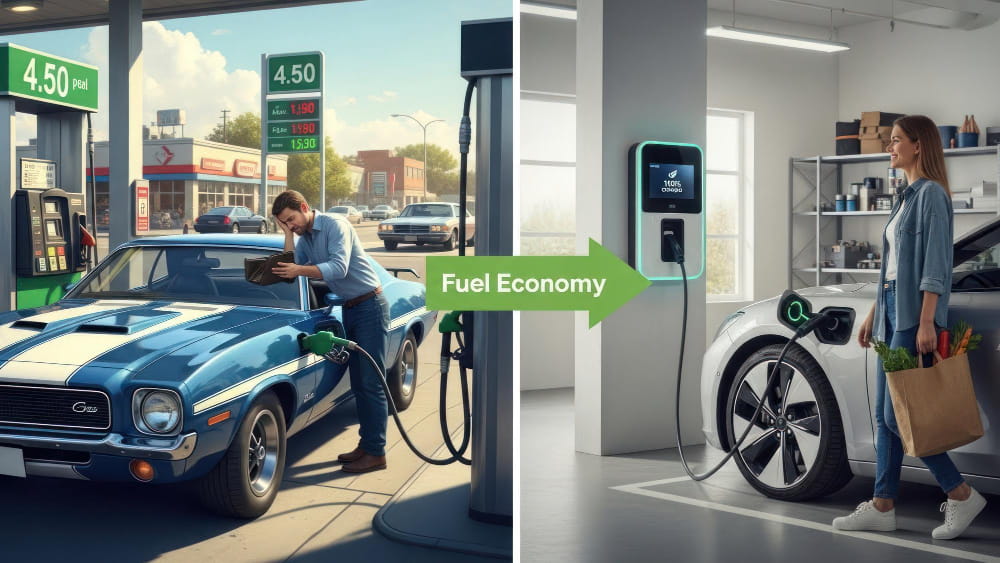
Choosing a new car in India has become more complicated than ever. With rising petrol and diesel prices, buyers are increasingly considering alternative fuel options such as Electric Vehicles (EVs) and CNG cars. Both technologies promise lower running costs and a greener driving experience, but they differ significantly in terms of ownership costs, convenience, performance, and long-term value.
So, if you’re confused between an EV vs CNG car in India, you’re not alone. Many first-time buyers struggle to decide which option suits their lifestyle and budget.
In this detailed comparison, we’ll compare EV vs CNG cars based on running cost, maintenance, range, performance, charging convenience, and overall ownership experience to help you make the right decision in 2026.
EV vs CNG Cars in India: Quick Comparison
| Parameter | Electric Vehicle (EV) | CNG Car |
|---|---|---|
| Purchase Price | Higher | Lower |
| Running Cost | ₹1–₹2 per km | ₹2.5–₹4 per km |
| Maintenance Cost | Low | Moderate |
| Refuelling/Charging Time | 30 minutes to 10 hours | 5–10 minutes |
| Driving Range | 250–600 km | 400–800 km |
| Environmental Impact | Zero tailpipe emissions | Lower emissions than petrol |
| Fuel Infrastructure | Growing rapidly | Well-established |
| Best For | City driving | City and highway driving |
EV vs CNG Running Cost: Which is Cheaper?
One of the biggest reasons buyers compare EV vs CNG cars in India is to reduce fuel expenses.
Electric vehicles offer the lowest running cost among all passenger vehicles. Charging an EV at home generally costs between ₹1 and ₹2 per kilometre, depending on electricity tariffs and driving conditions.
CNG cars are also economical, but their running cost is comparatively higher, averaging around ₹2.5 to ₹4 per kilometre.
Example Running Cost Comparison
| Vehicle | Approximate Running Cost |
|---|---|
| Tata Tiago EV | ₹1–₹1.5 per km |
| Tata Punch EV | ₹1.2–₹1.8 per km |
| Maruti WagonR CNG | ₹2.5–₹3 per km |
| Maruti Ertiga CNG | ₹3–₹4 per km |
For drivers covering more than 1,500 km every month, EVs can result in significant long-term savings.
EV vs CNG Purchase Price: Which Car Costs Less?
Purchase price remains a major deciding factor for most Indian buyers.
Electric cars continue to cost more because battery packs account for a significant portion of the vehicle’s price. Even though EV prices are gradually decreasing, buyers still need a higher initial investment.
CNG cars, on the other hand, are much more affordable. Factory-fitted CNG variants usually cost ₹80,000 to ₹1.5 lakh more than their petrol counterparts.
If your budget is limited, a CNG car offers a lower entry cost.
EV vs CNG Maintenance Cost Comparison
Maintenance is another area where electric vehicles perform exceptionally well.
Unlike CNG cars, EVs do not require:
- Engine oil changes
- Clutch replacements
- Exhaust repairs
- Spark plug replacements
- Engine-related servicing
Since electric vehicles have fewer moving parts, maintenance expenses remain considerably lower.
CNG cars still use traditional internal combustion engines and require periodic servicing similar to petrol vehicles.
EV vs CNG Range Comparison
Range is one of the most important factors when choosing between an electric car and a CNG car.
Most affordable EVs available in India currently offer a real-world driving range between 250 km and 450 km on a full charge. Premium EVs can deliver even higher ranges.
CNG vehicles generally provide a combined driving range of 500 km to 800 km when both petrol and CNG fuel tanks are considered.
If you regularly travel long distances or frequently drive on highways, CNG cars currently provide greater flexibility.
EV vs CNG Charging and Refuelling Convenience
Convenience is a critical factor in everyday ownership.
CNG refuelling typically takes less than ten minutes. However, in some cities, long queues at CNG stations may increase waiting times.
EV owners can conveniently charge their vehicles at home overnight, eliminating the need to visit fuel stations regularly. However, charging times remain significantly longer.
Typical EV Charging Times
- Home AC charging: 6–10 hours
- DC fast charging: 30–60 minutes
Buyers living in apartments without dedicated parking should carefully evaluate home charging feasibility before purchasing an EV.
EV vs CNG Performance: Which Feels Better to Drive?
Electric vehicles offer a superior driving experience due to instant torque and smooth acceleration.
Advantages of EV performance include:
- Instant acceleration
- Silent operation
- Smooth power delivery
- Automatic transmission convenience
- Minimal vibrations
CNG cars generally produce slightly lower power output compared to petrol versions, especially during overtaking or when driving with a full load.
For driving comfort and refinement, EVs generally provide a more premium experience.
EV vs CNG Cars: Which Is More Environment-Friendly?
Environmental impact is becoming increasingly important for Indian consumers.
Electric cars produce zero tailpipe emissions, helping reduce urban air pollution.
Although CNG vehicles emit significantly fewer pollutants compared to petrol and diesel cars, they still release carbon dioxide.
As India continues to increase renewable energy generation, EVs are expected to become even cleaner in the future.
EV vs CNG Infrastructure in India
India’s CNG network is well-developed in several cities, including Delhi-NCR, Mumbai, Ahmedabad, Pune, and Surat.
EV charging infrastructure is also expanding rapidly. However, public charging availability still varies across different regions.
Urban buyers with access to home charging may find EV ownership highly convenient, whereas highway travellers may still need to plan charging stops in advance.
Who Should Buy an EV?
An electric car is ideal if:
- Your driving is mostly within the city.
- You have access to home charging.
- You drive more than 1,500 km every month.
- You want lower long-term ownership costs.
- You prefer advanced technology and a refined driving experience.
Who Should Buy a CNG Car?
A CNG car may be a better option if:
- You have a limited budget.
- You frequently travel long distances.
- Home charging is not possible.
- You need quick refuelling convenience.
- You live in a city with strong CNG infrastructure.
Pros and Cons of EV Cars
Pros
- Lowest running cost
- Lower maintenance expenses
- Smooth and silent driving
- Zero tailpipe emissions
- Advanced connected features
Cons
- Higher purchase price
- Longer charging time
- Charging infrastructure is still developing
- Battery replacement costs can be high
Pros and Cons of CNG Cars
Pros
- Lower purchase cost
- Fast refuelling
- Extensive fuel network
- Better long-distance usability
Cons
- Reduced boot space
- Higher maintenance compared to EVs
- Lower performance than petrol variants
- Continued dependence on fossil fuels
Frequently Asked Questions (FAQs)
Is an EV cheaper to run than a CNG car?
Yes. In most cases, EVs have lower running costs than CNG cars, making them more economical for high-mileage users.
Which is better for long drives: EV or CNG?
Currently, CNG cars are generally more convenient for long-distance travel due to faster refuelling and a wider fuel network.
Is EV maintenance cheaper than CNG?
Yes. Electric vehicles require less maintenance because they have fewer mechanical components.
Can I charge an EV at home?
Yes. Most electric cars sold in India support home charging through dedicated charging equipment.
Which car is better for city driving: EV or CNG?
For city driving, EVs are usually a better choice because of lower running costs, smooth performance, and home charging convenience.
Final Verdict: EV vs CNG Cars in India
The EV vs CNG car debate does not have a single answer because the ideal choice depends on your driving habits and budget.
If your daily driving is mostly city-based, you have access to home charging, and you want the lowest possible running costs, an electric vehicle is a smart long-term investment.
However, if you frequently travel on highways, require quick refuelling, or are shopping on a tighter budget, a CNG car may be the more practical choice.
Ultimately, understanding your usage pattern is the key to making the right decision.
Which would you choose—an EV or a CNG car? Let us know in the comments below.
Share this content:

Post Comment