Long-Trip Charging Planning: The Complete Guide to Stress-Free EV Road Trips

The rise of electric vehicles (EVs) has transformed the way people travel, making long-distance journeys cleaner, quieter, and more economical. Modern EVs are capable of covering hundreds of kilometers on a single charge, making road trips more practical than ever before. However, successful long-distance EV travel requires a different approach than driving a conventional gasoline or diesel vehicle. Instead of relying on the next fuel station, EV drivers need to think ahead about charging locations, charging speeds, and battery usage throughout the journey.
Long-trip charging planning is not simply about finding the nearest charger. It involves understanding your vehicle’s capabilities, preparing an efficient route, accounting for weather and road conditions, and ensuring reliable charging options are available when needed. With the right preparation, range anxiety becomes a thing of the past, allowing drivers to focus on enjoying the journey rather than worrying about battery levels.
This guide explores every aspect of long-trip charging planning, providing practical insights that help EV owners travel confidently, reduce charging time, and make every road trip as smooth and efficient as possible.
Understanding the Importance of Charging Planning
Planning is the foundation of every successful EV road trip. While charging infrastructure continues to expand rapidly across highways, cities, and rural regions, charging stations are still not as widely available as traditional fuel stations. Additionally, charging times vary depending on the type of charger, the vehicle’s battery capacity, and the battery’s current state of charge.
Without proper planning, drivers may encounter occupied charging stations, unexpected detours, or reduced battery range caused by weather or terrain. These situations can lead to unnecessary delays and increased stress. A well-planned charging strategy ensures that each charging stop is intentional, minimizes waiting time, and provides enough battery reserve to reach the next destination comfortably.
Charging planning also helps drivers estimate travel time more accurately. Rather than viewing charging stops as interruptions, they can be integrated into meal breaks, sightseeing opportunities, or rest periods, making the overall journey more enjoyable and efficient.
Knowing Your Vehicle Before the Journey
Every electric vehicle behaves differently during long-distance travel. While manufacturers provide an official driving range, real-world performance depends on several factors, including driving speed, outside temperature, elevation changes, passenger load, and use of climate control systems.
Highway driving typically consumes more energy than city driving because the vehicle travels at sustained high speeds. Cold temperatures can reduce battery efficiency, while hot weather may increase energy consumption due to air conditioning. Similarly, carrying additional passengers or luggage adds weight, requiring more power to maintain speed.
Understanding these factors allows drivers to estimate a realistic driving range rather than relying solely on laboratory-tested figures. This realistic expectation forms the basis of effective charging planning and helps avoid unnecessary range anxiety.
Preparing the Route Before Departure
An efficient charging plan begins long before the vehicle leaves the driveway. Route preparation involves identifying charging stations along the intended path, verifying their charging speeds, checking operating hours where applicable, and considering alternative charging locations nearby.
Planning ahead provides flexibility if a charging station is occupied or temporarily unavailable. It also helps determine the most efficient locations for charging based on the vehicle’s battery level rather than simply stopping whenever the battery becomes low.
Modern navigation systems designed for electric vehicles automatically recommend charging stops based on battery status and destination. These systems continuously adjust the route if traffic conditions, weather, or energy consumption change during the journey, making travel more predictable and reliable.
Selecting the Right Charging Strategy
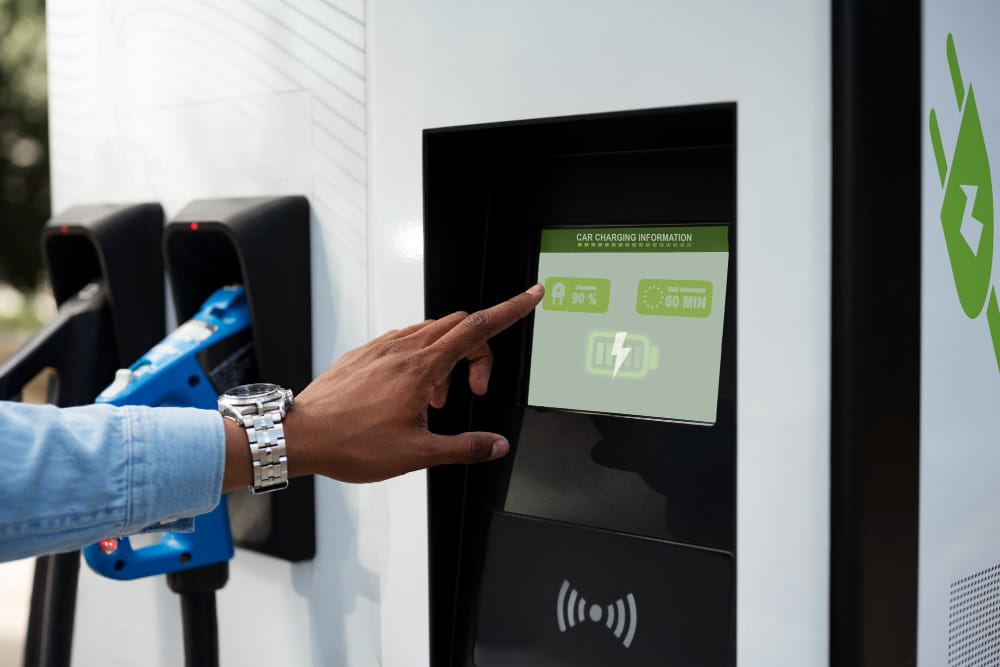
One of the most common misconceptions among new EV owners is the belief that the battery should always be charged to 100 percent at every stop. In reality, this approach often increases travel time because charging speeds decrease significantly once the battery reaches approximately 80 percent.
For long-distance travel, it is generally more efficient to perform multiple shorter charging sessions rather than waiting for a complete charge. Fast charging from a lower battery level to around 80 percent usually provides the best balance between charging speed and driving range.
This strategy not only shortens overall travel time but also aligns with the charging characteristics of most modern lithium-ion batteries. By understanding how charging curves work, drivers can maximize both convenience and efficiency throughout the trip.
Managing External Factors That Affect Battery Performance
Long-distance charging planning extends beyond the vehicle itself. Environmental conditions play a major role in determining how much energy the battery consumes.
Cold weather reduces battery efficiency and increases the energy required to heat the cabin, while extremely hot conditions may require continuous battery cooling and air conditioning. Mountainous terrain demands additional energy during uphill driving, although regenerative braking can recover some of that energy during descents.
Traffic conditions also influence battery consumption. Stop-and-go traffic often allows regenerative braking to recover energy, whereas uninterrupted highway driving generally results in higher overall consumption.
By considering these external influences before departure, drivers can create more accurate charging schedules and avoid unexpected battery depletion.
Choosing Reliable Charging Locations
Not all charging stations provide the same experience. Charging speed, reliability, payment options, and available amenities vary significantly between locations.
A well-planned charging stop offers more than electricity. Ideally, it provides access to restaurants, cafés, restrooms, convenience stores, or rest areas, allowing drivers and passengers to use charging time productively.
Reliability is equally important. Having a backup charging location within a reasonable distance ensures that unexpected equipment failures or occupied chargers do not disrupt the journey. This additional level of preparation adds confidence, particularly when traveling through unfamiliar regions.
Making Charging Stops Part of the Travel Experience
Charging breaks should not be viewed as wasted time. Instead, they can become natural opportunities to relax, recharge personally, and enjoy the surrounding environment.
Many experienced EV drivers intentionally schedule charging stops around meal times or scenic destinations. Rather than rushing through the journey, they use these intervals to stretch, explore local attractions, or simply rest before continuing.
This approach transforms charging from an inconvenience into a valuable part of the travel experience, making long road trips more comfortable and less physically demanding.
Preparing for Unexpected Situations
Even the best charging plans should include flexibility. Road closures, traffic congestion, adverse weather, or unavailable charging stations can require adjustments during the journey.
Drivers should begin each trip with the necessary charging cables, ensure their preferred charging applications are functioning, and verify payment methods before departure. Maintaining a healthy battery reserve instead of driving until the battery is nearly empty provides additional flexibility if unexpected detours occur.
Preparation for these situations reduces stress and enables quick decision-making without compromising safety or travel plans.
The Future of Long-Distance EV Travel
Electric vehicle infrastructure continues to evolve rapidly. Governments and private companies are expanding fast-charging networks, while newer vehicles offer longer driving ranges and faster charging capabilities than previous generations.
Emerging technologies such as ultra-fast charging, intelligent route optimization, battery preconditioning, and real-time charger availability are making long-distance EV travel increasingly convenient. Future innovations are expected to reduce charging times even further, bringing the experience closer to the convenience traditionally associated with fuel-powered vehicles.
As charging networks become denser and smarter, long-distance travel in electric vehicles will continue to become more accessible for drivers around the world.
Conclusion
Long-trip charging planning is the key to a successful electric vehicle journey. Rather than relying on spontaneous charging decisions, careful preparation allows drivers to optimize travel time, reduce energy-related concerns, and enjoy a smoother overall experience. Understanding real-world battery performance, selecting efficient charging strategies, considering environmental conditions, and preparing for unexpected situations all contribute to a more confident and enjoyable road trip.
With continuous improvements in EV technology and charging infrastructure, planning long-distance travel has never been easier. By adopting a thoughtful charging strategy, drivers can embrace electric mobility with confidence, knowing that every journey can be both efficient and enjoyable.
Share this content:


Post Comment